

8 min read
Digital Identity in Web 3 - Why is it crucial?
November 16, 2022
The rise of the Internet has completely transformed our lives, being present in almost everything we do and opening a new range of opportunities to make our life more simple and accessible.
The downside of the current state of the Internet is our little to no control over our data and identity. Our online behavior is being tracked and stored in big corporations' databases, and we do not know what they do with it and who they share it with.
With the emergence of Web3, where identity is expected to play a significant role, we expect this to change. The new digital identity management model will be a completely decentralized identity system in which users have complete control over their digital identity rather than storing it on centralized servers.
What is Web3?
Web3 (also known as Web 3.0) represents the next phase in the evolution of the Internet.
At the most basic level, Web3 refers to a decentralized online ecosystem controlled by users rather than governments and corporations, where security, privacy, and greater user utility are the key themes.
Web3 is powered by cryptography, token-based economics, and distributed ledger technologies like blockchain. So, to fully make Web3 a reality, a new identity layer providing users with more control and security over their data will be crucial.
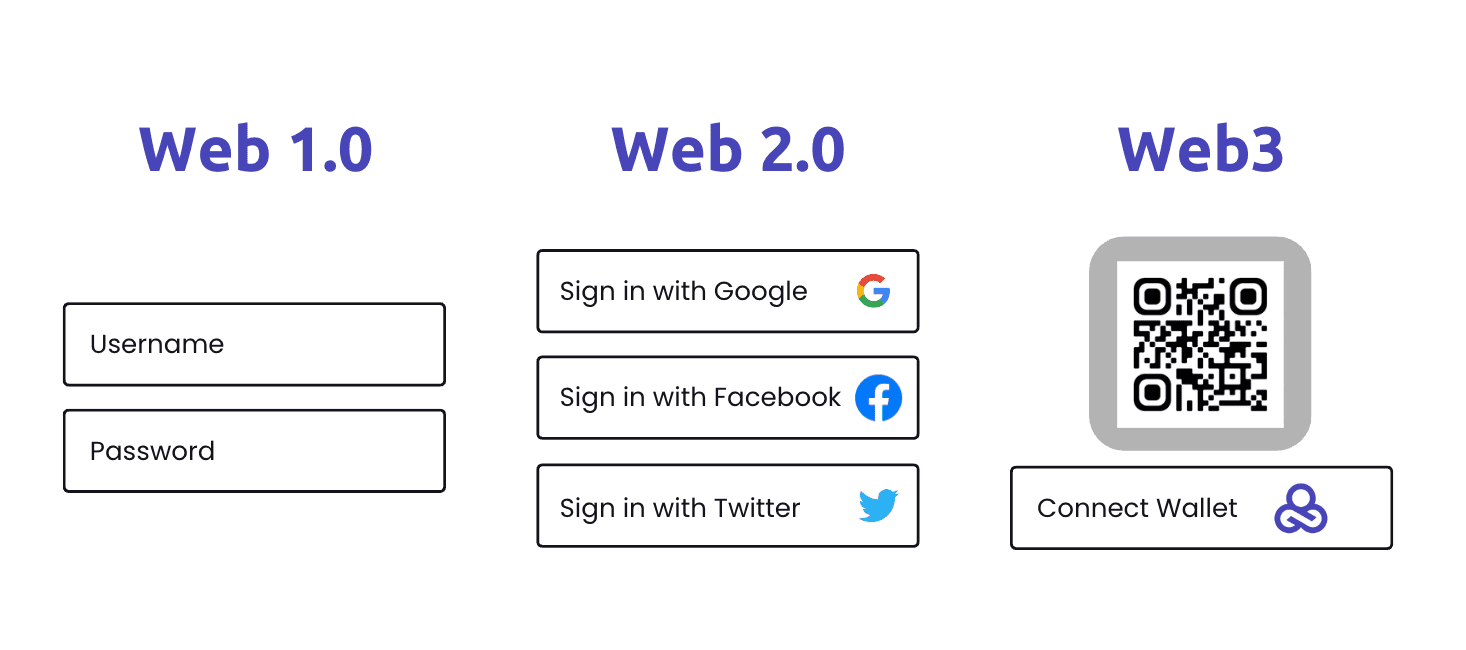
Web3 and Identity
Web3 will be a privacy-driven version of the Internet. But to yield the value of decentralization and privacy without compromising security and user experience, Web3 will need an improved identity management paradigm.
Self-Sovereign Identity is the identity layer that Web3 may need to become a reality, but before getting to this concept, let’s see how identity management has been handled in early web3 projects.
Early projects in Web3 and identity management
In the early stages of crypto and blockchain, anonymity was seen as a game changer and even considered one of the building blocks of Web3 as it was the method used to ensure privacy.
However, as Web3 started to grow, concerns about liability and money laundering started to arise, and the need for an identity layer took relevance. What Web3 needed is privacy, not anonymity.
Privacy ensures that users can keep information to themselves while not being tracked by a third party. Anonymity allowed the public to view the anonymous user's online activity while not being able to identify any personal information.
The identity matter became more sensitive with the expansion of DeFi and NFTs. The introduction of regulatory checks in DeFi created significant friction due to its fragmentation into different microservices, which resulted in users repeating KYC checks much more often than in traditional finance. This verification process involves a username and password and a long and bureaucratic Know-Your-Customer process, ultimately against the decentralized vision of Web3.
For NFTs, a new demand for identity originated with the need to demonstrate that a user is the creator and sometimes owner of an NFT. Consequently, some blockchain networks started including identity capabilities (typically including some ZKP mechanism) in their wallets.
Here, two versions surfaced:
- An utterly anonymous on-chain identity, but still an identity that can be publicly recognized (Public, anonymous, on-chain)
- A real identity, strongly linked to a physical person and using old-school centralized models based on accounts, passwords, and KYC checks. (Private, identified, off-chain)
The first version includes examples such as Vitaliks' Soulbound tokens, which are permanent, non-transferable NFTs. However, these are public and on-ledger by default, meaning these identities are linked to a specific blockchain network and, therefore, not interoperable across chains.
The second version includes examples such as Crypto.com or Coinbase's account-based identity.
As anonymity slowly lost its usefulness for many use cases and linkability to real identities was sought, other approaches to anonymous on-chain identities appeared. One such example is Polkadot Identity, which allows users to proactively add personal information to their on-chain account and subsequently ask for verification of this information by registrars. All while regulated projects looked desperately for more private, decentralized alternatives to traditional identity verification solutions.
Self-Sovereign Identity (SSI) technology may just be the solution for them all, an architecture that brings the benefits of decentralization to both compliant and pseudonymous identity management.
Self-Sovereign Identity could be the ideal identity layer for web3
Self-Sovereign Identity (SSI) is a nascent technology that solves the flaws of the current identity management paradigm. SSI differs from previous models in allowing users to control their data and hold pre-verified identity documents in a digital wallet. Its default private mode gives the holder more control over their personal data and how it is accessed.
This is achieved through tamper-proof verifiable credentials (machine-verifiable digital identity documents), Decentralized Identifiers (DIDs), and optionally Distributed Ledger Technologies (DLTs), hand in hand with the use of ID Wallets.
In simpler words, Self-Sovereign Identity presents a user-centric approach where individuals securely exchange authentic and digitally verified information with the simplicity and usability of a Single Sign-On (SSO), all while sharing the decentralized vision of Web3 that aims to give users back control of their data.
How could Web3 benefit from SSI?
As we’ve seen, the principles and mission of Web3 lead to Self-Sovereign Identity. With both working towards the same goal, some expected benefits of implementing SSI technology in Web3 will be:
- Security by design: User data and ID credentials are protected with biometrics and post-quantum cryptography for maximum protection.
- GDPR & KYC compliance is engrained: Users hold pre-verified identity information and decide with whom to share their personal data and when to revoke access, naturally complying with data privacy regulations.
- Interconnection with Web 2.0: SSI can be used in both Web 2.0 and Web3 instances. For example, it can be used for traditional banks and crypto exchanges.
- Decreased cyberattacks and identity fraud: Through the elimination of centralized databases & passwords, it is almost impossible for hackers to steal private information.
- Improved user experience: No more lengthy Know-Your-Customer (KYC) forms that force users to fill in the required information manually repeatedly. SSI enables compliant, instant & reusable KYC through passwordless authentication, eliminating friction during onboardings and simplifying the sign-in process.
- Ledger-agnostic: SSI can interconnect with blockchain network providers and centralized architectures.
SSI Use Cases in Web3
There are many use cases for SSI in Web3, but the most important are portable, verifiable digital identities, which apply to most sub-sectors such as DeFi, NFTs, gaming, metaverse, and DAOs.
- DeFi - SSI eliminates the need for multiple, siloed identities in DeFi. The primary use case is reusable KYC for crypto/ICOs, leading to instant, compliant, and secure onboarding into DeFi platforms. Similarly, DeFi exchanges and dApps can play an issuer role by issuing KYC credentials to users who have passed through the KYC.
- NFTs – Within the NFT sector, SSI can help in proving the ownership of NFTs across their lifecycle. Another use case includes the human verification of real users for mints, drops & auctions to decrease the chances of price manipulation and bots.
- Gaming & Metaverse – Verified and interoperable data will be essential in the metaverse, whether for initial identity verification when creating user profiles, to ensure a safe place to work in the metaverse, or to securely port avatars and digital objects/assets from one dimension of a metaverse to another.
- DAOs – Integrating DIDs into DAO platforms adds a layer of security to safeguard users from identity theft and scams. Users can participate in certain governance-related events in a privacy-preserving manner by requesting specific verifiable credentials. For example, Collector DAOs can request VCs that ensure they are unique individuals to enable a true one-person-one-vote model.
How Gataca Studio can help develop Web3 projects
Until now, the implementation of Self-Sovereign Identity technology involved complex workflows requiring many hours of consultation and expert deployment guidance, creating a massive barrier to adoption. Gataca Studio crushes this barrier.
Gataca Studio is a low-code decentralized identity verification platform designed for businesses that wish to implement full-stack SSI tech with little integration effort.
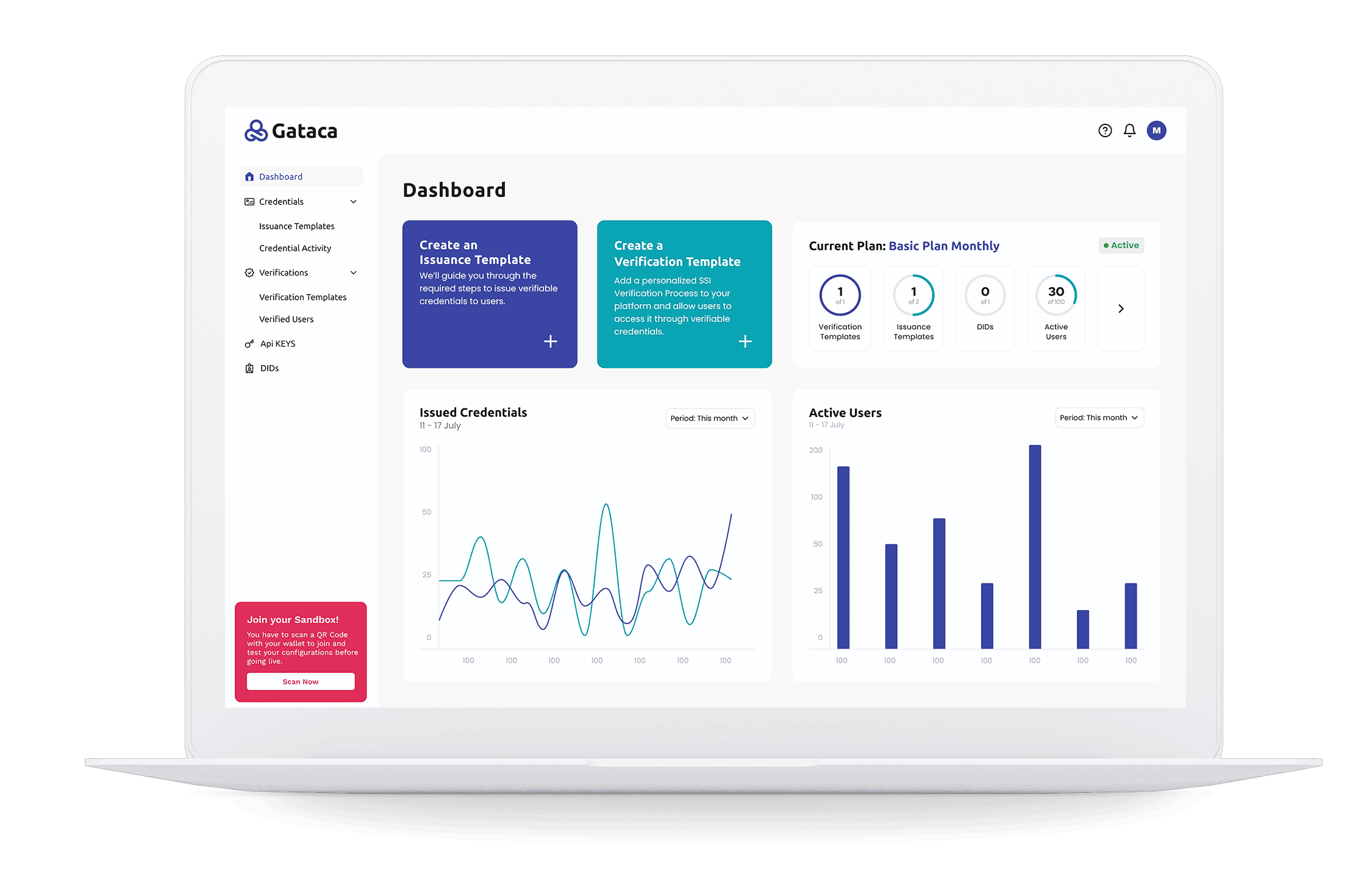 Through a monthly subscription and a seamless integration, you can start implementing Self-Sovereign Identity into your own Web3 solutions. What can you do with Gataca Studio?
- Issue your own credentials: Create, validate, and digitally sign identity credentials. You can easily create credential issuance templates to integrate an issuance process into your website or application.
- Authenticate users in just one click: Gataca Studio enables you to quickly create customizable verification templates for onboarding and sign-in processes while reducing personal data stored in your infrastructure.
- Manage identity credentials in one place: Gataca Studio lets you effortlessly manage your company’s issued credentials, their status, and verified users from one dashboard.
Food for thought
Decentralized identity schemes are making good progress and could be the tip of the iceberg of the Internet's evolution towards web3 with the goal of fostering more transparent, democratic, private, and trustworthy information exchange schemes without handing over our digital identity to large corporations.
However, there are still some challenges ahead:
- Interoperability is a must. Will this requirement favor a market with a myriad of wallets or just a handful of dominating wallets that manage to work across different sectors, geographies, and infrastructures? In the last case, how can we ensure that these wallets keep the user’s best interests at heart?
- With governments in Europe working their way to build government ID Wallets, will these be extended for use in web3, or will users have government ID wallets only for government and traditional industries authentication and web3 wallets for anything else? In this last case, will government ID wallets meet their promise to become an economic growth driver?
Time will tell.

Esther Saurí
Digital Marketing