

5 min read
Success Story: ERUA & University of the Aegean
January 10, 2024
ERUA (European Reform University Alliance) is a collaborative project involving the University of Konstanz, Paris 8 University, Roskilde University, New Bulgarian University, and the University of the Aegean/UAegean (ERUA Alliance is currently under a reorganization as more Universities join now the Alliance).
As part of EBSI's Early Adopters program, ERUA has initiated a pilot project to provide registration and access to workshops and courses to the members of the Alliance via ERUA-iD, integrating self-sovereign identity technologies in alignment with EBSI and eIDAS 2.0 initiatives.
On September 25-26, 2023, the University of the Aegean (UAegean), member of ERUA and technical leader of this project, hosted the initial workshop to put the technical solution into action (a pilot case supported also by the EWC project)
The Problem
ERUA aims to cultivate a stronger sense of community, transcending geographical boundaries and grounded in shared values and interests among its members, including students, teachers, researchers, and non-academic staff.
However, ERUA members may have to juggle multiple sets of login credentials to access services both within their institution and across other universities in the alliance, hindering the sentiment of a unified community.
Adding to the challenge, academic achievements within the alliance mostly rely on paper-based documentation, lacking automatic recognition among member universities. This results in time-consuming administrative tasks, especially with ERUA's course offerings and workshops, which have seen a surge in demand for micro-credentialing.
Recognizing the pressing need for a common digital identity and a shared infrastructure across the University Alliance, ERUA sought a solution that not only needed to address the previous challenges but also provided deployment flexibility, customization, and controlled access permissions while ensuring compliance with the upcoming eIDAS 2.0 regulation.
The solution for a common digital identity became clear: the implementation of Verifiable Credentials utilizing EBSI ecosystem tools and with a technology partner that would support them along the way, Gataca.
Issues addressed:
- Eliminating the inconvenience of managing multiple login credentials.
- Unifying a fragmented identification system.
- Transitioning from paper-based records to an automated system for recognizing achievements.
- Avoiding high infrastructure costs associated with changes in membership.
The Solution
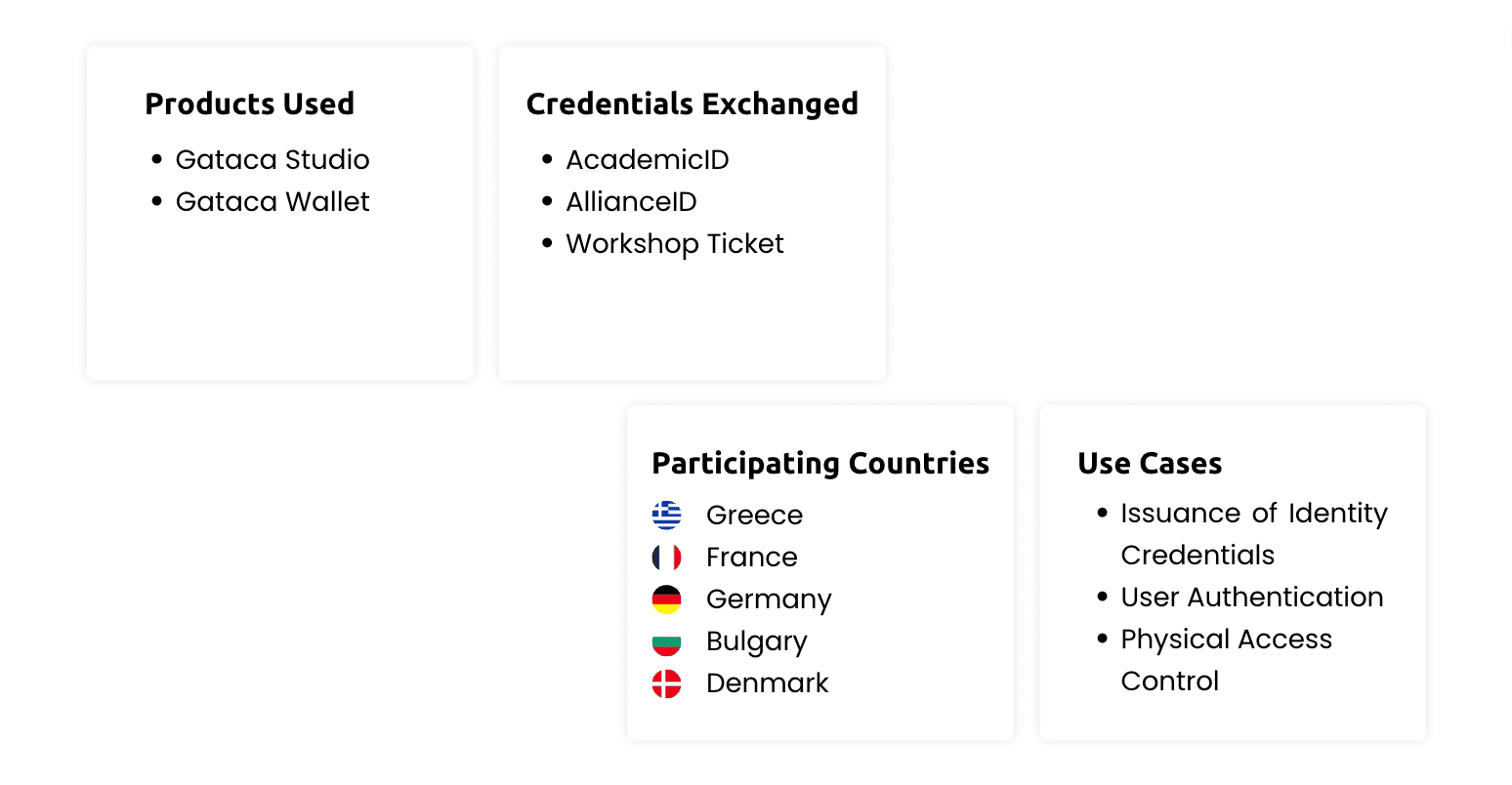
Using Gataca's Self-Sovereign Identity solution, ERUA created a common digital identity for students, staff, and administrators, known as ERUA-iD, as well as other credentials, to facilitate the seamless exchange of credentials in various settings, both inside and outside of the University Alliance.
This solution was tested in a workshop hosted by the University of the Aegean, serving as a real-world testing ground for evaluating the usability of an early prototype of the European Digital Identity (EUDI) Wallet - aligned with EWC objectives - the Gataca Wallet.
ERUA harnessed Gataca Studio for the organizations involved, an all-in-one decentralized identity SaaS platform to issue, verify, and manage verifiable credentials, and Gataca Wallet, an ID Wallet designed for individuals to securely store verifiable credentials and easily share them for identity verification.
The Approach: ERUA Workshop
1. Integration with Gataca
Only two weeks before the workshop, the University of the Aegean created the issuance and verification templates needed to exchange different types of credentials, with all workshop stakeholders initiating the integration of Gataca Studio into their existing systems.
Gataca Studio offers open APIs to integrate existing systems, applications, and third-party services, making the deployment a breeze.
It is important to note that Gataca Studio has a readily available sandbox environment enabling organizations to instantly test their issuance and verification process configurations with zero integration efforts.
2. Issuance and Authentication of ERUA-iD
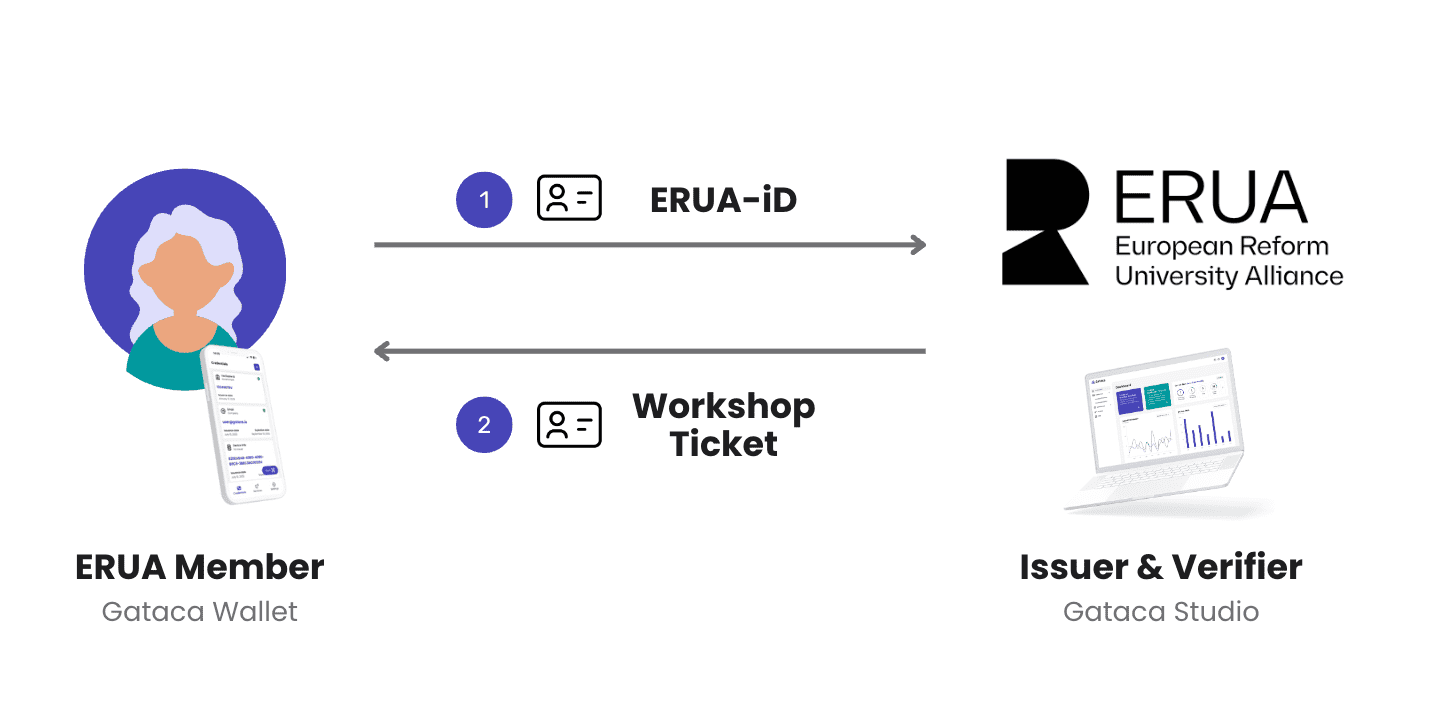
Once the integration was complete, the next step was for ERUA members interested in participating in the workshop to request the ERUA-iD on their alliance website.
The ERUA-iD is a set of personal and academic attributes in the form of a W3C Verifiable Credential stored in a mobile wallet that enables users to authenticate as members and access online services offered by ERUA, including workshops, courses, and university facilities.
The ERUA-iD was issued to the Gataca Wallet once they were authenticated using their University Credentials.
3. Issuance of Workshop Ticket
With the ERUA-iD stored in the Gataca Wallet, participants just had to share it to request the Workshop Ticket in the event portal. ERUA automatically verified their identity and issued the workshop ticket as a Verifiable Credential.
4. Workshop Ticket Presentation
With the ERUA-iD stored in the Gataca Wallet, participants just had to share it to request the Workshop Ticket in the event portal. ERUA automatically verified their identity and issued the workshop ticket as a Verifiable Credential.
The Impact
The initial project demonstrated the viability of the implemented technical solution based on self-sovereign identity technology, presenting an optimistic scenario for its potential deployment in a live production environment.
The incorporation of verifiable credentials has paved the way for the automatic recognition of cross-border academic and identity credentials among ERUA alliance universities and other relevant stakeholders. The impact of this implementation is notable:
✅ Automatic issuance and recognition of digital credentials, simplifying and accelerating the verification process for all parties involved.
✅ Support for multiple alliance memberships, facilitating access to services and resources across various domains.
✅ Flexible infrastructure that can be adaptable to meet the evolving needs of the alliance.
✅ Improved user privacy and control. Users can easily manage who can access their data and revoke access anytime.
✅ Enhanced security and UX as the solution combines the simplicity and usability of a Single Sign-On with advanced cryptography.
What’s next?
The pilot use cases will extend into 2024. This phase involves testing travel and proximity scenarios, including attending workshops by ferry or plane (issuing boarding passes to the EUDI Wallet) and making identity-based payments through third-party services, such as hotel reservations, car rentals, etc (within the EWC framework).
Additionally, the University of the Aegean (UAegean) is leading in implementing ERUA-iD through Verifiable Credentials. These credentials will cover various aspects, such as student identity, qualifications earned within ERUA education and research exchanges, and the transfer of transcripts and credits both before and after enrollment in ERUA activities.
This comprehensive initiative is designed to establish an entire ecosystem in which ERUA-iD serves as a central component, and Gataca will support its development.

Esther Saurí
Digital Marketing