

7 min read
EUDI Wallet and AMLR: The Regulations Reshaping iGaming Identity Verification in 2027
May 27, 2026
European iGaming operators are entering the biggest identity and AML compliance change in years.
Between late 2026 and 2027, the industry will need to adapt to three major changes happening at the same time: the new Anti-Money Laundering Regulation (AMLR), the launch of AMLA as the EU’s central AML supervisor, and the rollout of the European Digital Identity Wallet (EUDI Wallet) under eIDAS 2.0.
These developments are deeply connected.
The AMLR raises and standardizes the rules around who operators must verify and how customer due diligence should be performed. AMLA is the authority that will oversee whether those controls are actually effective across the EU. And the EUDI Wallet introduces a new model for identity verification that makes compliant onboarding faster, reusable, and interoperable across borders.
What's changing for iGaming in 2026 and 2027?
Three dates are worth keeping on your roadmap:
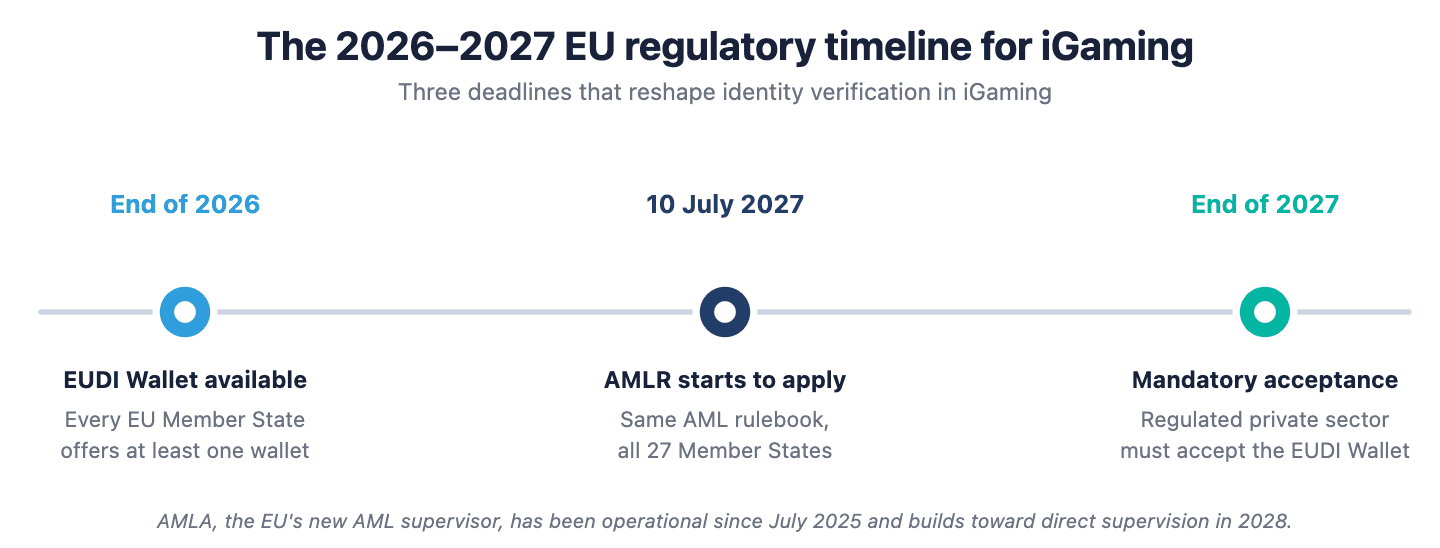
- By end of 2026 — Every EU Member State must make at least one EUDI Wallet available to its citizens, residents, and businesses (under Regulation (EU) 2024/1183, "eIDAS 2.0").
- 10 July 2027 — The new Anti-Money Laundering Regulation (AMLR, Regulation (EU) 2024/1624) starts to apply directly in all 27 Member States.
- By end of 2027 — Regulated private-sector services that already use strong user authentication must accept the EUDI Wallet as a valid login and identity-verification method.
Article 5f of eIDAS 2.0 says that any private company (except micro and small enterprises) legally or contractually required to use strong user authentication must accept the EUDI Wallet.
Gambling isn't named explicitly, but iGaming operators are already subject to AML, KYC, and national gambling laws that demand strong authentication so the sector falls inside the scope by default.
On top of all that, the new EU Anti-Money Laundering Authority (AMLA) has been operational since July 2025. It's publishing dozens of technical standards through 2026 in preparation for full direct supervision in 2028, and iGaming sits clearly inside its remit.
Why these changes are deeply connected for iGaming?
On paper, eIDAS 2.0, the AMLR, and AMLA look like three separate files. In practice, they reinforce each other. Here's the simple way to think about it:
- eIDAS 2.0 creates the trusted identity. The EUDI Wallet is a EU-wide, government-issued container for verified digital credentials such as proof of age, identity, residence, or "no exclusion list" attestations.
- The AMLR defines what you must verify. Customer due diligence (CDD), beneficial ownership checks, ongoing monitoring, source-of-funds — and it explicitly recognises eIDAS-compliant electronic identification as a valid means to do that verification.
- AMLA polices how well you do it. The new supervisor expects structured, auditable identity processes (exactly what a wallet-based flow produces by design).
How the EUDI Wallet directly impacts iGaming operators
Here are the 3 ways the wallet rollout changes day-to-day operations for iGaming platforms.
1. Mandatory acceptance by end of 2027
By end of 2027, you will be required to accept the EUDI Wallet as a valid method of strong user authentication and identity verification. That covers account opening, login, age verification, transaction approval, and any other flow where you already do "strong" authentication.
For most operators, this means the wallet sits alongside (and increasingly replaces) document upload, selfie liveness checks, and federated logins.
2. KYC at the assurance level AMLR demands
The AMLR sets uniform CDD requirements that replace the patchwork of national rules. It explicitly recognises eIDAS-compliant electronic identification (exactly what the EUDI Wallet provides) as a valid way to perform customer due diligence. Credentials issued at the "substantial" or "high" assurance level meet the new single-rulebook bar.
In practical terms:
- One-tap KYC at sign-up, sourced from government-grade credentials.
- No more OCR on blurry photos of driving licences and no more 1–48 hour approval queues.
- A clean audit trail as every credential share is cryptographically signed and timestamped.
3. AML and the audit trail AMLA expects
AMLA is preparing direct supervision from 2028 and will look for structured, traceable identity and due-diligence processes. The wallet model is built for this:
- Verified credentials from trusted issuers cut the risk of synthetic identities, bonus abuse, and account takeover.
- Ongoing due diligence (re-verification, sanctions screening, source-of-funds) gets faster because the underlying credentials are already trusted.
- Every share is logged with a verifiable timestamp and the player's explicit consent which is the kind of evidence a supervisor wants to see.
Why traditional KYC flows struggle to keep up
Most current iGaming onboarding flows were not designed for this regulatory environment. The standard process still looks like this:
- Manual data entry
- ID upload
- Selfie or liveness check
- OCR processing
- Manual or semi-manual review
- Approval delays
That sequence creates familiar problems: high onboarding friction, repeated verification across operators, more fraud exposure, expensive operations, and large volumes of sensitive data sitting in your systems waiting to become a breach headline.
It also creates duplication that the player can feel. Someone who already finished KYC with one regulated platform usually has to do the entire thing again the next time they sign up somewhere else. That model does not scale well into the reusable identity era.
How reusable identity changes the flow
Reusable identity flips the process. Instead of verifying users from scratch every time, operators rely on digitally signed credentials already stored in the player's wallet.
The flow becomes much simpler:
- The player connects their identity wallet.
- The operator requests the credentials it needs.
- The player consents to sharing them.
- Verification happens instantly.
This shrinks onboarding from minutes or hours to seconds. Gataca's wallet-based onboarding flow, for example, is designed to complete identity sharing in under 5 seconds. The operator receives verified information directly from trusted issuers — governments, banks, certified identity providers — with no document upload in sight.
For your players, the experience is closer to paying with Apple Pay than filling in a 12-field form. A player verified in Spain can prove they're over 18 and resident in Spain to your platform in Malta in seconds, without you running a separate KYC. Once they're inside your platform, signing in, withdrawing funds, or proving source of funds becomes a tap rather than a fresh document upload.
We covered the underlying mechanics in our earlier guides on ID Wallets in iGaming and reusable identity. What's new in 2026–2027 is that the regulatory framework — AMLR, AMLA, eIDAS 2.0 — is now built around this exact model.
The business case beyond compliance
Compliance is the floor, not the ceiling. Operators who move first typically see:
- Onboarding times drop from 1–48 hours to under 5 seconds. No document upload, no liveness retry, no support ticket.
- Drop-off rates fall sharply. Traditional KYC flows lose 25–40% of sign-ups; one-tap wallet flows recover most of that.
- Fraud losses go down. Cryptographically signed credentials and our intelligence layer with trust scoring gets anomalies before they can make damage.
- Operating and compliance operating costs go down too. Reusable identity lowers KYC costs and automated verification reduces manual review steps.
The reusable identity market is forecast to grow from $32.8 billion in 2022 to $266.5 billion by 2027 — a ~69% CAGR. That's the broader signal: every regulated sector your players use is moving the same way.
What happens if you wait?
The risks go beyond simply being late to adopt another new technology. Once mandatory acceptance takes effect at the end of 2027, failing to support the EUDI Wallet will mean non-compliance with a directly applicable EU regulation, arriving at the same time AMLA’s single rulebook comes into force.
There is also the customer expectation factor. As banks, telecom providers, and government services begin accepting the wallet as standard, players will quickly notice when their iGaming platform still relies on slower, more fragmented onboarding flows.
And the commercial impact is likely to compound fast. Operators that integrate the EUDI Wallet early will be able to onboard players more quickly and at lower cost, creating a growing advantage in conversion, acquisition efficiency, and operational spend.
How Gataca helps iGaming operators get there
Gataca provides a turnkey solution specifically designed for the iGaming sector.
You get pre-configured EUDI Wallet integration, AML and KYC verification flows aligned with the AMLR, and ongoing support as the regulation evolves without building the underlying identity infrastructure yourself.
If you're mapping your 2026 and 2027 roadmap right now, this is the part of it worth getting right early. Talk to our team about a wallet-based onboarding for your platform.

Esther Saurí
Digital Marketing