

10 min read
Unleashing the Power of User Experience in Self-Sovereign Identity
May 29, 2023
User experience (UX) plays a role in identity management solutions by ensuring that the interactions with the system are as satisfactory and efficient for the users as possible. But here's the thing: privacy, security, and user experience used to be a balancing act - you couldn't have it all.
Self-Sovereign Identity (SSI) has been the game-changer in solving this tradeoff, creating user-friendly interfaces while enhancing privacy and security.
In this blog post, we’ll explore how although the technical aspects are essential, the role of UX in Self-Sovereign Identity cannot be underestimated in its success.
Understanding Self-Sovereign Identity (SSI)
Before we dive into the nitty-gritty of UX in Self-Sovereign Identity, let's take a moment to refresh your memory on this technology. Ever wished you had complete control over your digital identity? Well, say hello to self-sovereign identity (SSI).
Self-Sovereign Identity is a nascent technology that solves the flaws of the current identity management paradigm. SSI differs from previous models in allowing users to control their data and hold pre-verified identity documents in a digital wallet. Its default private mode gives the holder more control over their personal data and how it is accessed.
This is achieved through tamper-proof verifiable credentials (machine-verifiable digital identity documents), Decentralized Identifiers (DIDs), and optionally Distributed Ledger Technologies (DLTs), hand in hand with the use of ID Wallets.
If you're itching to learn more about SSI and dive deeper into this exciting world, be sure to check out our SSI Essentials article.
The Role of UX in Self-Sovereign Identity
User experience is the leading force behind the success and acceptance of any technology, and Self-Sovereign Identity is no exception. Let's face it, even the most groundbreaking tech can flop if users struggle to navigate it.
That's where UX swoops in to save the day. In the world of SSI, UX plays a critical role in ensuring ease of use and reducing barriers to entry, promoting wider adoption of this technology.
1. Simplicity
When it comes to UX design, simplicity is all about making things easy to grasp for users, despite their technical knowledge. We want to avoid any head-scratching moments and keep everything straightforward. Here are some tips to achieve that coveted simplicity:
- User Interface (UI) should be clear, well-organized, and free of unnecessary complexity
- Simplify processes by cutting down on unnecessary steps
- Keep the messaging simple and easily understandable
- Boost user understanding through visual elements
Simplicity is achieved in Self-Sovereign Identity technology by prioritizing a user-centric design through all the interactions and flows of the ecosystem. To better understand simplicity applied to SSI on a more practical level, let’s see it in a credential management example using Gataca Wallet:
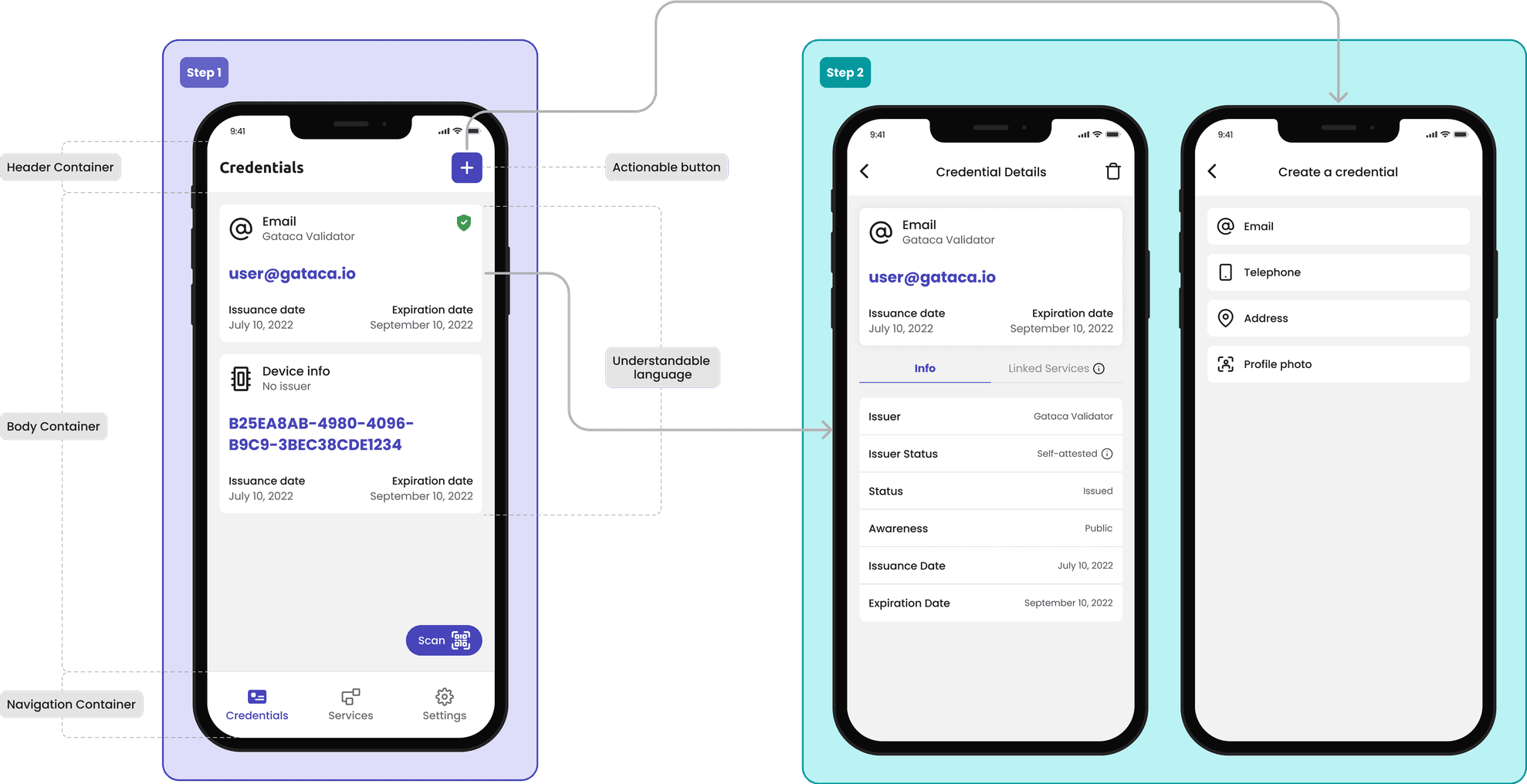
As you can see, simplicity is being achieved by all the points mentioned before:
- The user interface is free of unnecessary complexity and with an organized structure of containers, where the user can easily find a header, a body, and navigation with the key functionalities.
- The managing credentials process is simplified by having main actionable buttons that allow interactions with just a tap and minimize the number of steps required.
- We ensure clear and concise communications with user-friendly language. Users do not need to understand the technical details - it is time to say goodbye to complex jargon or confusing terms.
- And finally, we use visual elements to let the user know actions without stuffing the design. This would be, for example, the “plus sign” icon on the header container that lets the user know they can add something without the need to have it explicitly explained.
Therefore, a simple UX design is essential to ensure that users can easily understand and manage their identities without requiring specialized technical knowledge or extensive training.
2. Clear and Transparent Control
Self-Sovereign Identity puts individuals back in control of their personal information, and user experience (UX) has a crucial role in making this control a reality.
Intuitive design elements are the muscle behind empowering users to take charge of their data. With these elements in place, users can easily understand and manage what information they share, who they share it with, and why.
This is new territory for users, so UX in Self-Sovereign Identity technology needs to ensure users are greeted with plain and straightforward language supported by helpful visual cues and easily adjustable privacy settings that guide users from the get-go.
When using a digital wallet, how does this work? At Gataca, user experience is one of our defining features, so we are constantly working on improving it. Look at this video to see how we ensure clear and transparent control through selective disclosure and explicit data consent.
Easy right? Let’s see how UX plays a part in it.
- Clear Information: Users are presented with clear and concise information about the data requested for disclosure. They are informed about the purpose of data sharing, who will have access to it, and how it will be used. No mysteries here!
- Granular Consent Options: Users can choose exactly which specific data elements they're comfortable sharing and with whom. They can selectively grant or deny consent for each piece of information, giving them precise control over their data.
- Transparency in Recipients: Users are provided with transparent information about the recipients of their data. They know who will receive their information and can make informed decisions based on trust and relevance.
- Easy Management: Users can easily modify their consent choices at any time. We provide simple options for them to update their preferences, ensuring ongoing control and flexibility.
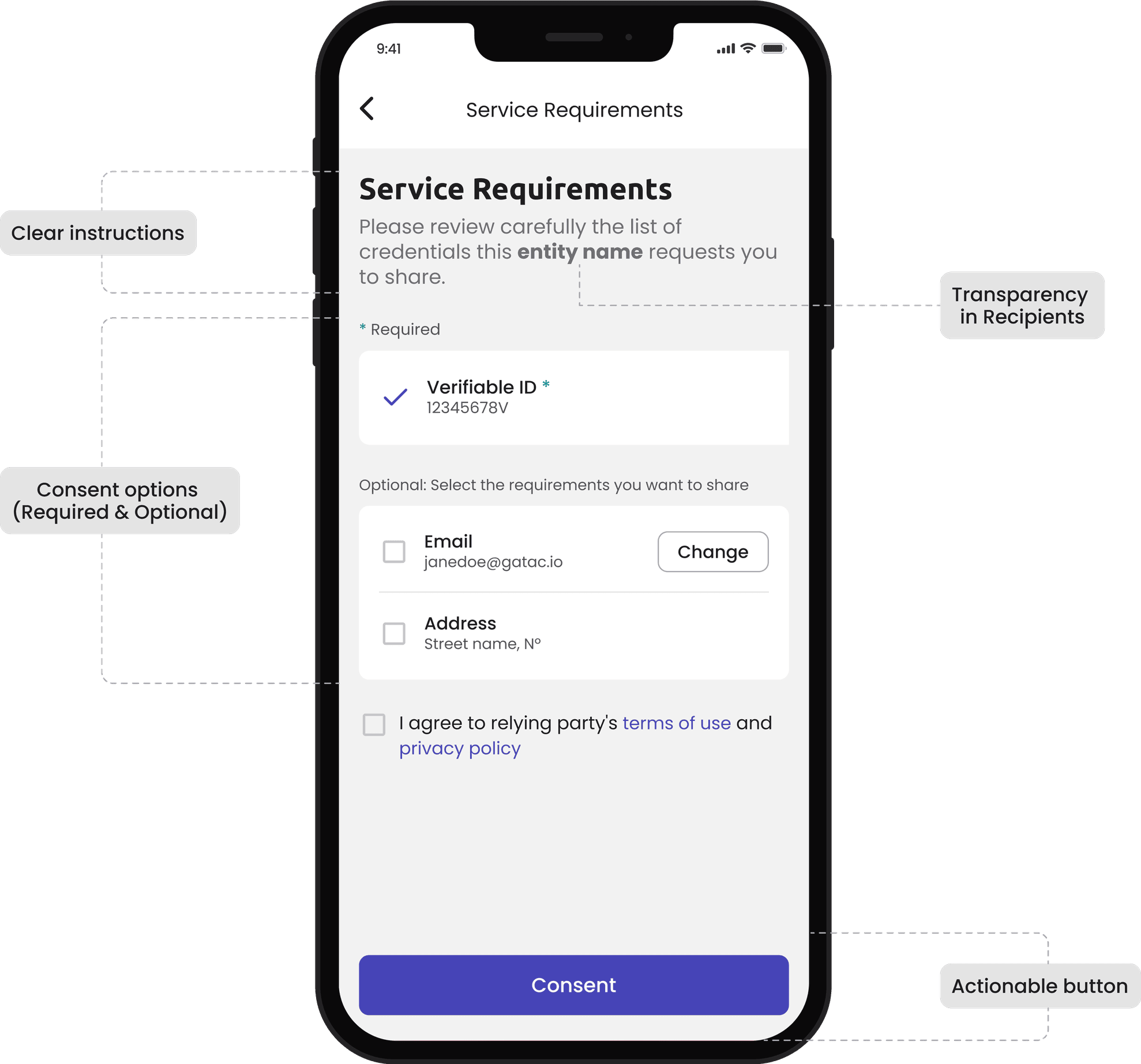
With a user-centric approach and these UX features, we're making sure individuals have the clarity and transparent control they deserve. Self-Sovereign Identity is all about empowering users, and our UX is here to make that happen.
3. Seamless Interoperability
UX design ensures that SSI solutions are interoperable with various platforms and applications. By enabling smooth integration between different systems, UX facilitates the seamless sharing and verification of credentials across multiple domains.
To better understand this concept, we need first to showcase how to use a digital wallet to access a digital service:
The process is similar to what we've discussed earlier, but now let's take it a step further. What if you want to access not just one but multiple accounts like your bank account, university account, healthcare account, and more? That's where Self-Sovereign Identity and its seamless interoperability come into play.
You can now access multiple accounts by simply sharing a credential, eliminating the need for separate usernames and passwords. Here's a visual representation to help you understand how this works and how it adapts to UX:
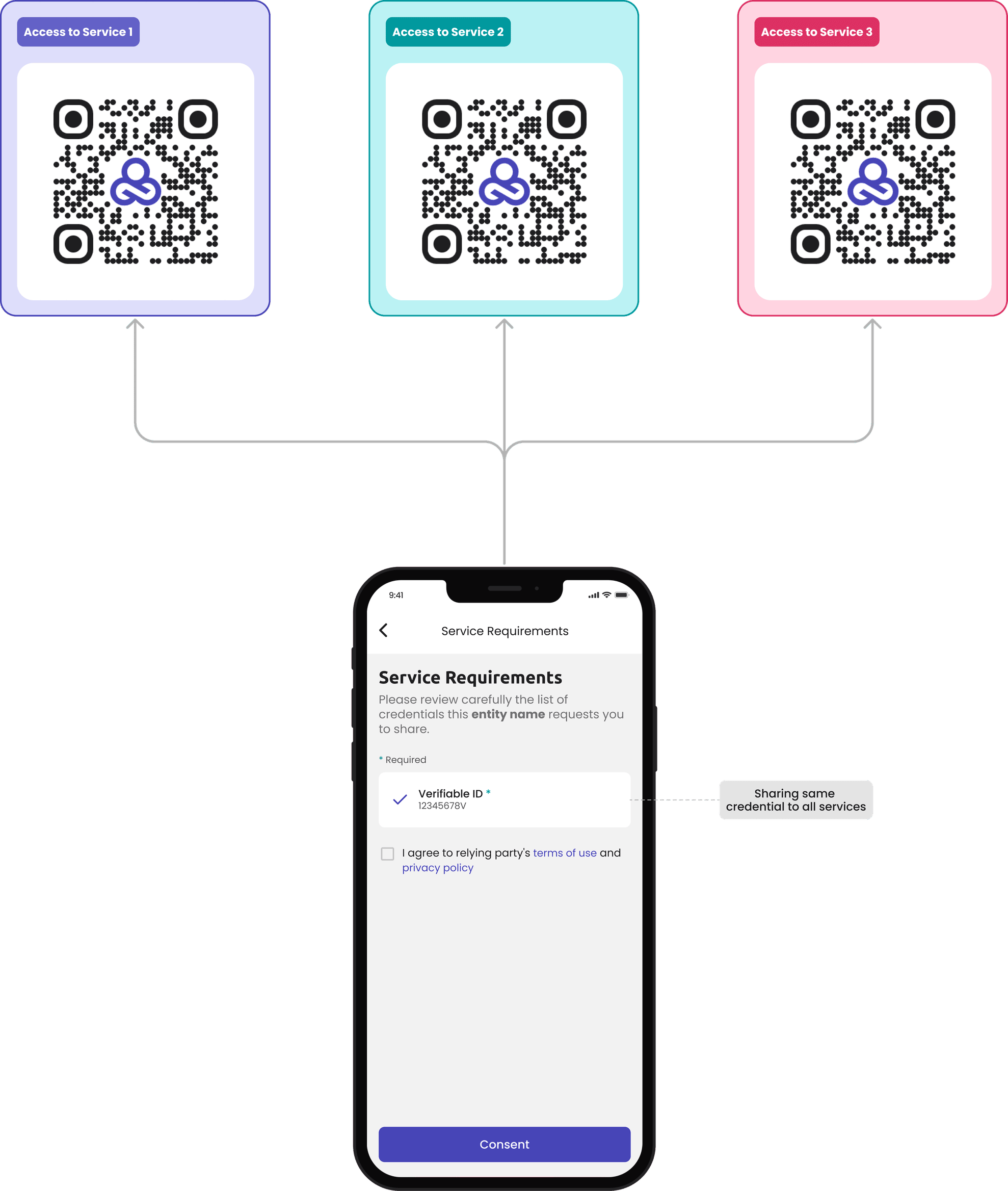
In this scenario, UX takes center stage once again:
- We ensure a cohesive and consistent user interface across different platforms.
- We reduce the learning curve by making the initial process easy to understand, so users only need to replicate it for different accounts.
- And we provide a familiar interaction pattern by always presenting the user with a QR code as the access tool.
4. Enhanced Security and Privacy
Privacy and security are paramount when it comes to digital identity. That's why the UX role is to communicate the robust security measures in place, instilling confidence in users adopting Self-Sovereign Identity.
Two-factor authentication, biometric recognition, and encrypted communications are just a few of the features that keep your data safe and confidential.
On a day-to-day basis, we download, use, and interact with different platforms that use authentication methods, but they go unnoticed. That’s the magic of good UX, making the user do an action without thinking. And when it comes to SSI and the combination of biometric recognition with UX, it's a match made in heaven.
With biometric recognition, you can use your unique biological characteristics like fingerprints, facial features, or iris patterns to verify your identity. Biometric recognition technology compares the captured biometric data with previously enrolled data to verify the user's identity:
At Gataca, we provide clear instructions for enrolling your biometric data, and we've added intuitive prompts for capturing your biometric information during authentication. It's all about making the process easy so you can breeze through it without breaking a sweat.
Remember, biometric data is unique to you, making it nearly impossible for others to impersonate you. By integrating biometric recognition into our UX design, we add an extra layer of protection to your accounts. Your security and privacy are our top priorities, and we've got you covered.
5. Education and Empowerment
Getting users on board and educating them about the benefits and potential of Self-Sovereign Identity is important to driving adoption. But let's face it, SSI can be a complex concept to wrap your head around. That's where UX design is the king by simplifying concepts, providing interactive tutorials, and guiding users throughout their journey.
By encouraging an environment of continuous learning, UX empowers you to make informed decisions and fully grasp the transformative potential of SSI.
One way we do this is through onboarding processes that guide you step by step. Take a look at our wallet tutorial, for example.
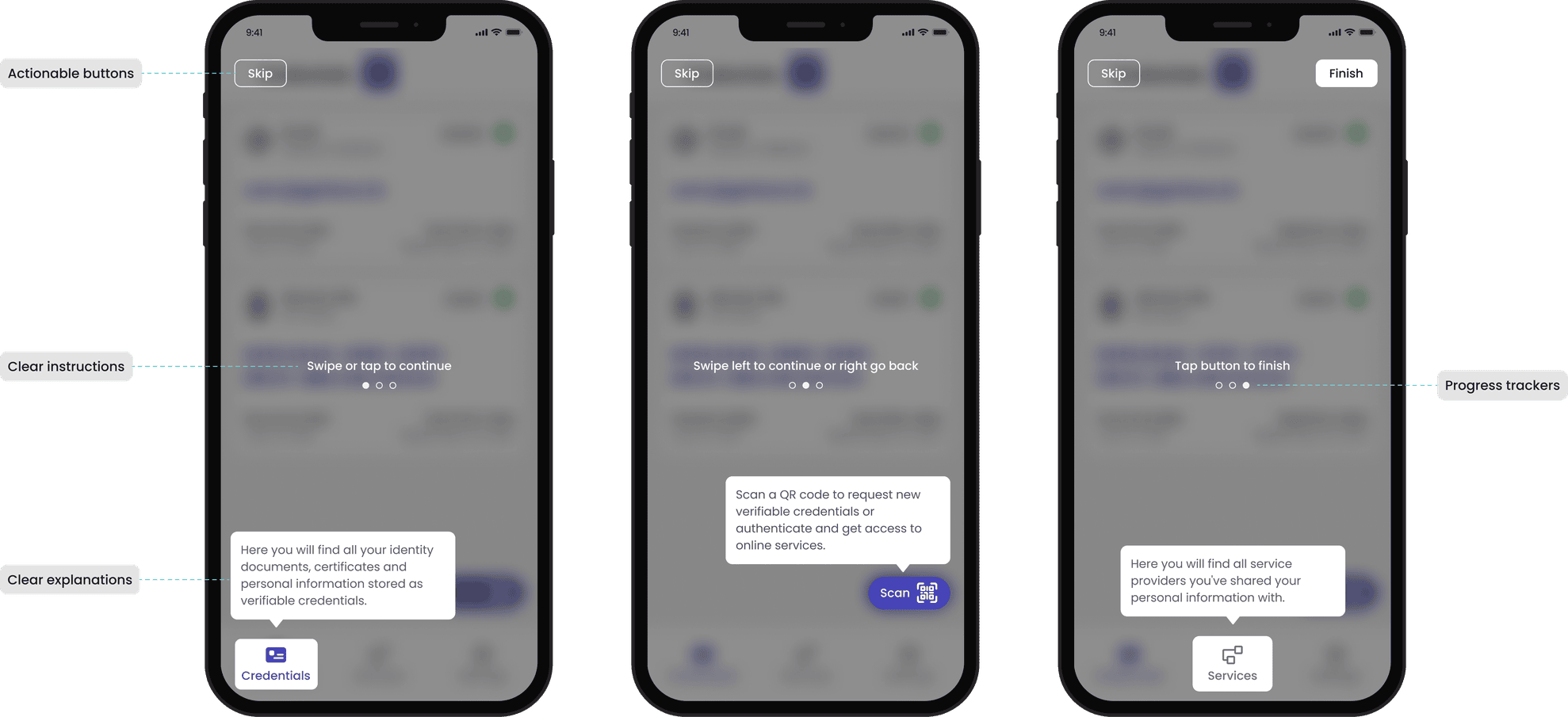
At Gataca, we implement this type of guide showing how to navigate through the digital wallet:
- User-Friendly Interface: The instructions and explanations are presented in a clear and concise manner, free from technical jargon so you won't feel overwhelmed or lost. We want you to easily navigate the tutorials with intuitive controls and interactive elements.
- Progress Tracking: The UX design includes features to keep tabs on how far you've come. Whether it's completion indicators, badges, or rewards, we want to motivate you and give you that sense of accomplishment as you advance through the learning process.
6. Accessibility
Accessibility ensures that the Self-Sovereign Identity is usable by a wide range of users, including those with varying abilities and disabilities. It involves designing the system to be inclusive and accommodating to different user needs:
- Consider Different Devices: Design the onboarding process to be responsive and compatible with various devices like smartphones, tablets, and computers. Ensure that the interface is optimized for different screen sizes and input methods.
- Support Assistive Technologies: Make the SSI system compatible with assistive technologies like screen readers or voice commands. Provide alternative text for images and ensure interactive elements are accessible via keyboard navigation.
- Contrast and Readability: Use appropriate color contrasts to ensure readability for users with visual impairments. Choose fonts and font sizes that are legible and easy to read. Consider the needs of users with color blindness or other visual challenges.
- Error Handling and Feedback: Provide clear and descriptive error messages to help users understand and resolve issues. Use visual and auditory feedback to indicate the completion of tasks or errors in the input.
While we're committed to improving accessibility, we acknowledge that there's still work to be done. At the moment, we are implementing accessibility by implementing responsive design principles and building a robust design system that considers factors like contrast ratios, font sizes, and spacing to enhance readability. Additionally, we focus on creating components that have effective error and success handling.
UX4SSI Working Group: Paving the Way for Mass Adoption
At Gataca, we place a strong emphasis on User Experience (UX), being a core value of our solution. However, we know UX impacts SSI interoperability, yet there is still work to be done in establishing technical specifications and best practices at the UX level.
To address this need, we have established the UX4SSI Working Group. This initiative brings together various stakeholders, including technology providers, regulatory bodies, UX designers, and end-users.
Our aim is to explore the intersection of UX and SSI, fostering collaboration among diverse perspectives. If you are eager to contribute and engage in this important conversation, join here.

Estefanía Zambrano
UX/UI Designer